SL Optic Documentation
SL Optic is a professional 4-channel bidirectional SDI-to-fiber media converter designed for mission-critical broadcast and production environments. It converts uncompressed SDI video signals to optical and back across four independent channels, enabling lossless transmission over distances up to 60 km.
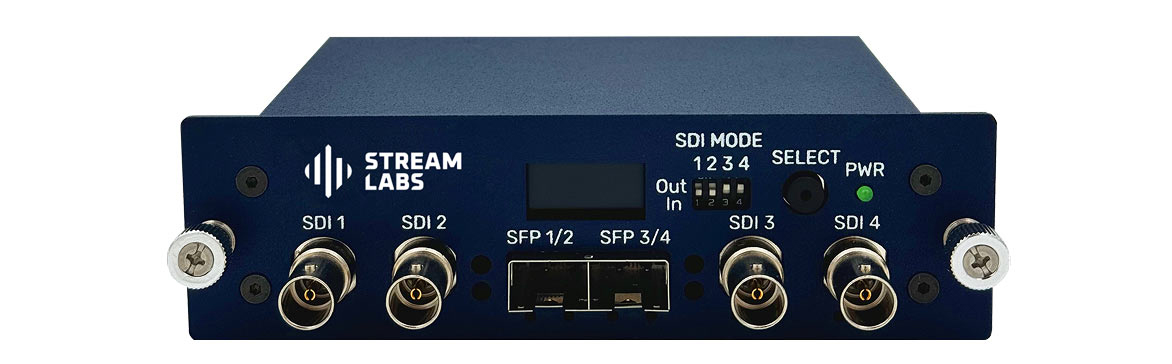
What SL Optic Does
Each of the four channels can independently operate in either direction — SDI-to-fiber or fiber-to-SDI — making SL Optic equally suited for sending signals from a studio to a remote site and for receiving them back. Channel direction is set via front-panel DIP switches, with no software configuration required.
Optical connectivity is provided through hot-swappable SFP modules. Each module handles two optical channels, so two modules cover all four channels of the device. The modular SFP design supports CWDM wavelength multiplexing, allowing multiple channels to share a single fiber strand.
Key Features
- 4 independent bidirectional channels — each channel configurable as SDI input or output, independently of the others
- Full SDI format support — 12G-SDI, 3G-SDI, HD-SDI, SD-SDI, and ASI
- Up to 60 km transmission — lossless, zero-latency optical transport
- Hot-swappable SFP modules — flexible optical connectivity; supports CWDM for multi-channel over single fiber
- CDR (Clock and Data Recovery) — maintains signal integrity by recovering clock from incoming data, preventing jitter accumulation over long links
- Dual redundant power supply — two independent PSUs for uninterrupted operation in critical environments
- Front-panel display — monochrome LCD showing signal status, optical power levels, and channel direction
- DIP switch configuration — direct hardware control, no software or network access required
- Rack-mountable — available as standalone unit or 1U chassis fitting up to three units
Typical Use Cases
| Use Case | Description |
|---|---|
| Studio-to-transmission plant | Extend 12G-SDI feeds from a production studio to a transmitter or satellite uplink over dark fiber |
| Remote production (REMI) | Transport multiple camera feeds from a remote venue back to a central production facility |
| Inter-building links | Connect equipment across buildings or campus locations without signal degradation |
| Signal distribution | Fan out a single SDI source to multiple destinations via optical infrastructure |
| Outside broadcast | Feed signals from an OB truck into a facility over long-distance fiber runs |
Deployment Example — Remote Production (REMI)

Getting Started
- Review the hardware — front panel, rear panel, and form factor options
- Install and connect the device — mounting, SFP modules, cabling, power
- Configure channel directions — set DIP switches for each channel
- Read the display — understand what each screen shows
What's Not in This Device
SL Optic is a hardware converter with no embedded web interface, REST API, or network management port. Configuration is entirely physical — DIP switches on the front panel. The rear-panel USB-micro connector is a factory service port and is not intended for use during normal operation.