Replacer T2MI
Local content insertion into DVB-T2 multiplexes without rebuilding the multiplex at every site
DVB-T2 T2-MI MPEG-TS Multiple PLP EWS ASI
Replacer T2MI takes two input streams — the national one and the local one — and puts selected local services on air in place of the original services inside the same multiplex. T2-MI and MPEG-TS are both supported, and the output format matches the input, so the modulator and transmitter downstream keep working as they are.
- Replaces TV channels inside PLPs in both Multiple PLP and Single PLP streams.
- Replaces SI tables so receivers see a consistent multiplex.
- Returns to the original stream automatically if the local feed fails.
- Uses relay bypass on power loss to keep the site on air.
- Provides a web interface and SNMP for remote and unattended sites.
The problem
Regional programming has to go on air at specific sites, at specific times, inside a multiplex that was built somewhere else and delivered to every site as one T2-MI stream.
The usual ways to do that are a full local headend at each site or a second distribution chain to each region. Both cost far more than the few hours of local content they carry, and both add a point where a failure takes the site off air.
Regional content goes on air where it is needed without rebuilding the multiplex or deploying a full local headend at every site.
What Replacer T2MI does
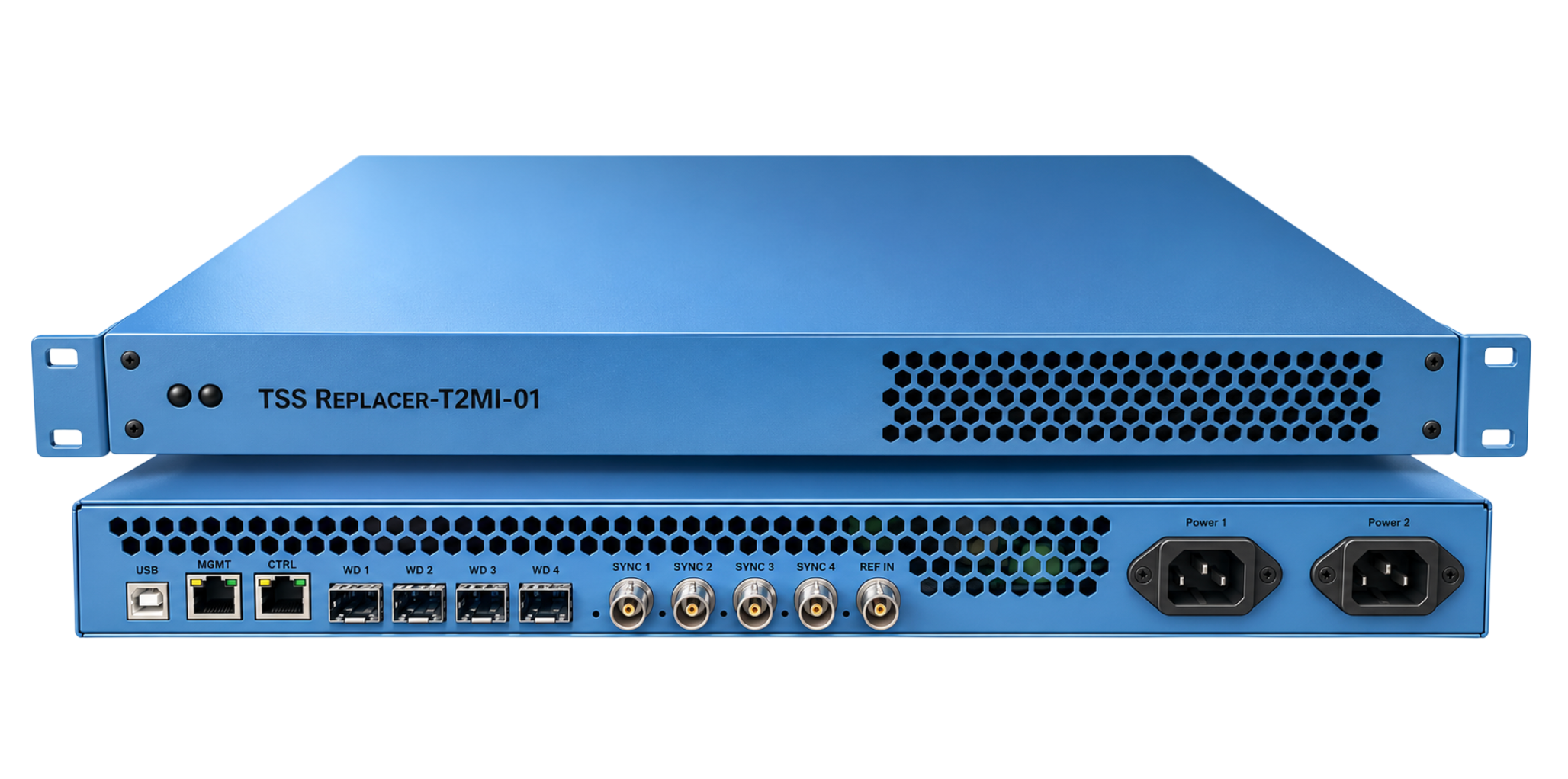
Replacer T2MI is a 1U device installed at the transmitter site or at the regional headend. It receives the original and the local stream, in T2-MI or MPEG-TS, and outputs a single stream in which the chosen services have been replaced by their local versions.
The multiplex structure is preserved. The PLP layout stays as delivered; NIT, SDT and EIT are updated to match what is actually being transmitted; and the output goes to the existing DVB-T2 modulator or transmitter over ASI.
The site keeps one device to configure and monitor instead of a local headend, while the national network keeps its single point of multiplex creation.
Key capabilities
Channel replacement inside PLPs
Original services are replaced with their local versions directly in the T2-MI stream. Multiple PLP and Single PLP streams are both supported, so the device fits networks that carry several PLPs with different robustness settings as well as simpler single-PLP configurations.
SI table replacement
NIT, SDT and EIT are replaced together with the content. Receivers in the region see correct service names, network information and programme guide data for the version of the multiplex they are actually receiving, instead of the national listing.
Automatic failover to the original stream
If the local T2-MI stream is lost or fails quality checks, the device passes the original stream through. The regional window is interrupted; the channel is not.
Relay bypass on power loss
A hardware relay bypass connects input to output if the device loses power. Combined with two independent power inputs, this keeps a transmitter site transmitting through a power event, which matters most at sites with no permanent staff.
If the local feed fails, the original stream stays on air. If the device loses power, the hardware relay bypass keeps the signal path connected.
Emergency warning support
The device supports EWS integration, so emergency alerts can be delivered through the same terrestrial network that carries regular programming.
Monitoring and diagnostics
Status, stream parameters and alarms are available through the web interface over HTTPS and through SNMP. Error logs and statistics stay on the device, giving engineering teams evidence after an incident rather than a guess.
Use cases
Regional opt-outs in a national DTT network
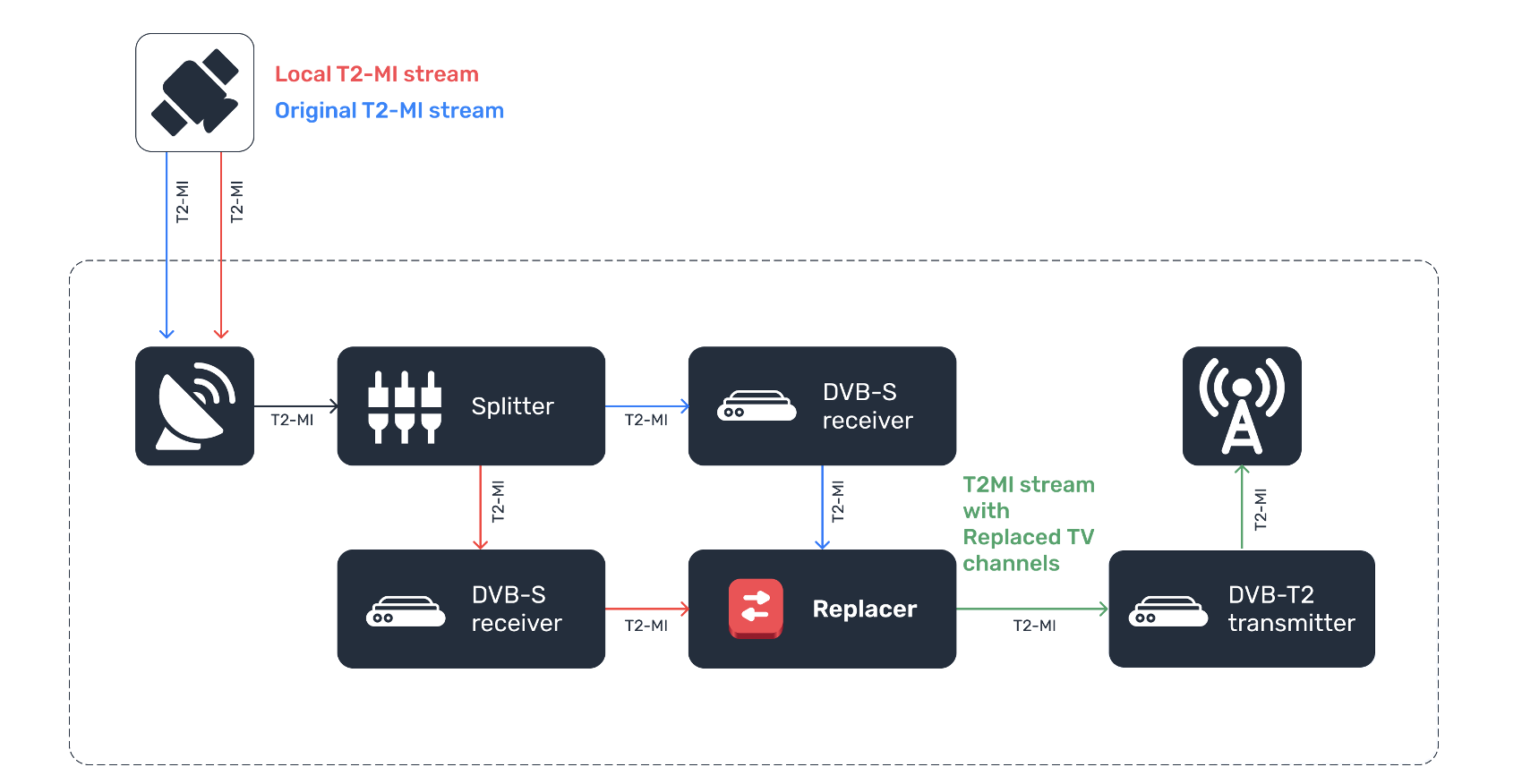
The national multiplex arrives by satellite as T2-MI. A splitter feeds two DVB-S receivers, one for the original stream and one for the local stream. Replacer T2MI performs the substitution and hands the result to the DVB-T2 transmitter.
Local stream delivered over fiber, IP or microwave
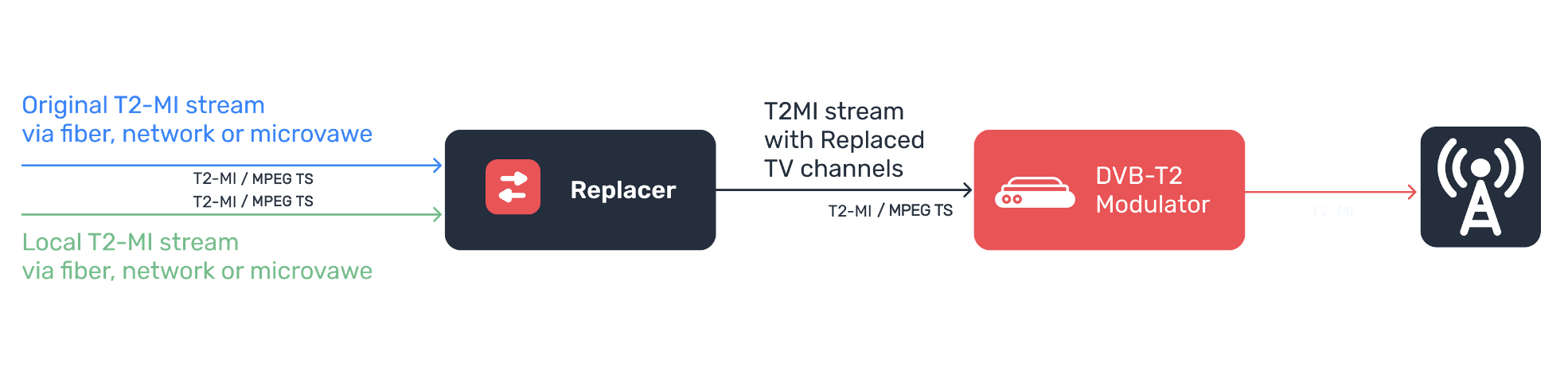
Where the regional feed reaches the site by terrestrial link rather than satellite, both streams go straight into the device, in T2-MI or MPEG-TS, and the output goes to the DVB-T2 modulator.
Regional news windows and local advertising
Sites running scheduled local programming or regional advertising insert it into the national multiplex without a separate regional distribution chain.
Unattended and remote transmitter sites
SNMP alarms, web access and hardware bypass make the device workable at sites that are visited only a few times a year.
Emergency warning delivery
Networks with public warning obligations can use the terrestrial multiplex as the alerting path.
Technical specifications
Stream processing
- MPEG-TS and T2-MI stream processing
- Multiple PLP and Single PLP
- Replacement of original TV services with local versions in PLPs
- Replacement of SI tables: NIT, SDT and EIT
- T2-MI output multiplex via ASI
- Failover passthrough and relay bypass modes
- Error logging and statistics
ASI and SDI interfaces
- ASI inputs: 2 (ASI 1, ASI 3), BNC
- ASI output: 1 (ASI 2), BNC
- SDI / ASI ports: 4 total, BNC
- Sync input: 1, BNC
Management and service
- Management: 1 active port (MGMT 1), RJ45 Ethernet
- Protocols: HTTPS and SNMP
- SFP slots: 4, not used in the current configuration
- Service port: 1, USB-B
Power
- Power inputs: 2, IEC320
- Power supply: 220 V AC ±10%, 50 Hz
- Power consumption: ≤ 300 W
Environmental conditions
- Operating temperature: +5 °C to +40 °C
- Storage temperature: 0 °C to +45 °C
- Relative humidity: 20–80%, non-condensing
Mechanical specifications
- Dimensions (W×H×D): 483 × 44 × 310 mm
- Weight: ≤ 5 kg
- Form factor: 1U rack-mounted
- Service life: 10 years
Business benefits
- One device per site instead of a local headend
Regional insertion is handled by a single 1U unit at the transmitter site. Capital cost and engineering effort scale with the number of sites, so the difference between a device and a headend is multiplied across the network. - Regional inventory without a second distribution chain
Local programming and regional advertising become available at each site using the existing national multiplex delivery. - Licence and regulatory compliance
Local content obligations and emergency warning requirements are met inside the existing terrestrial network. - Lower risk of on-air failure
Automatic return to the original stream and hardware bypass cover the two most common ways a regional insertion point takes a channel off air.
Deployment and integration
Replacer T2MI is installed at the transmitter site or the regional headend, between the stream sources and the DVB-T2 modulator or transmitter. Inputs and output are ASI; management uses a single RJ45 port with HTTPS and SNMP.
The device does not change the downstream chain. Existing modulators, transmitters and antenna systems stay in place.
FAQ
Does Replacer T2MI re-modulate the signal?
No. It processes the T2-MI stream and outputs T2-MI over ASI. Modulation stays with your existing DVB-T2 modulator or transmitter.
Does it work with Single PLP streams?
Yes. Both Multiple PLP and Single PLP T2-MI streams are supported.
What happens if the local stream disappears?
The device passes the original stream through, so the national version of the channel continues on air.
What happens if the device loses power?
A hardware relay bypass connects the input to the output, and the site keeps transmitting the original stream. The unit also has two independent power inputs.
How is the device managed and monitored?
Through a web interface over HTTPS and through SNMP, from a single management port. Error logs and statistics are kept on the device.
Can it be used for emergency warning messages?
Yes. The device supports EWS integration.
Does it handle plain MPEG-TS as well as T2-MI?
Yes. Both input streams and the output can be MPEG-TS, which covers sites where the multiplex is delivered as a transport stream rather than as T2-MI.