Level 2 — Quality Indicators
Level 2 errors indicate deviations from the MPEG TS standard that may or may not cause visible service degradation, but always warrant investigation.
Prerequisite: Before interpreting Level 2 errors, confirm there are no Level 1 errors active (particularly CCE on the relevant PIDs). Many Level 2 errors are secondary effects of CCE.
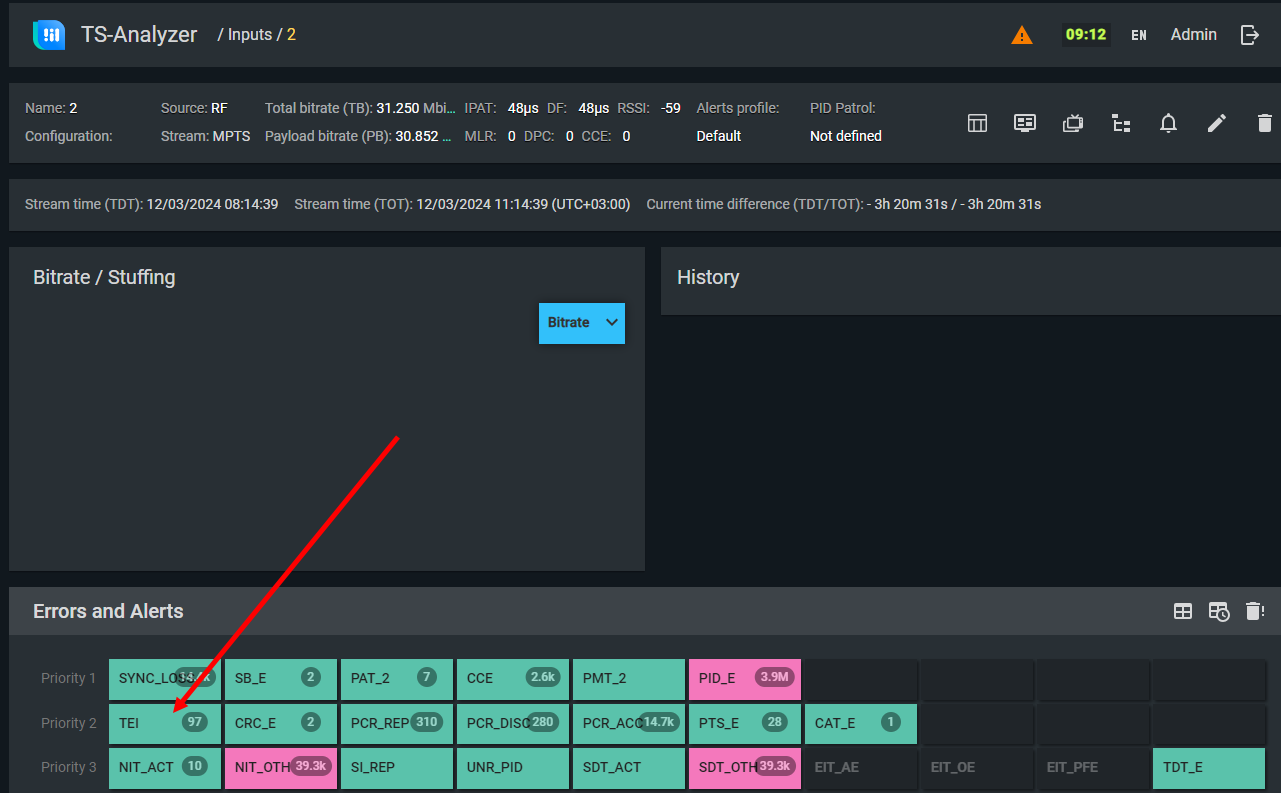
2.1 Transport_error
Abbreviation: TEI
Frequency: Very rare
What it means
One or more TS packets have the Transport Error Indicator (TEI) flag set in their packet header. This flag marks the packet as known-defective. The standard requires receivers to discard TEI-flagged packets without generating further errors.
In practice, not all receivers respect this requirement — some process the defective packet anyway, causing errors similar to CCE.
Causes
- A device in the chain (typically the multiplexer, or a demodulator that sets TEI on uncorrectable packets) has flagged corrupted packets.
- TS corruption from interference, combined with a device that sets TEI rather than discarding corrupted packets.
Recommendations
Identify which device set the TEI flag by tracing the stream back toward the source. Consult that device's documentation for the conditions under which it sets TEI. In most cases this indicates upstream signal quality problems.
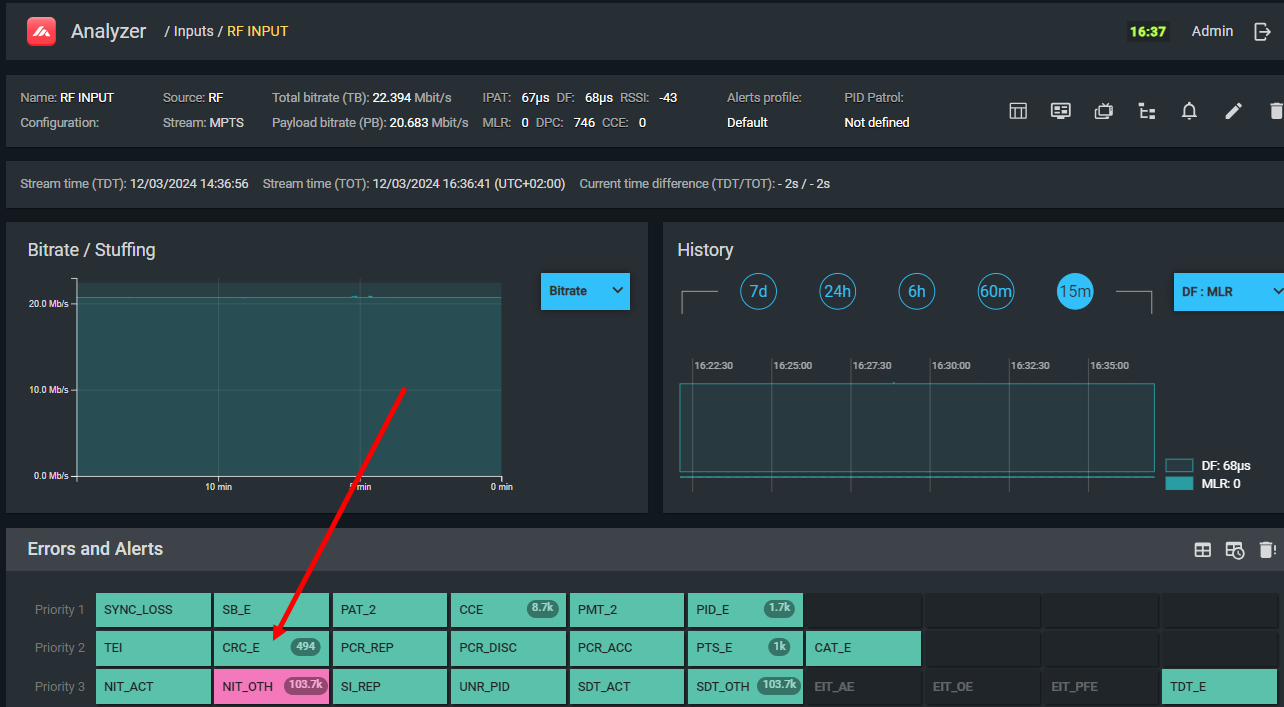
2.2 CRC_error
Abbreviation: CRC_E
Frequency: Rare
What it means
The CRC checksum of a PSI/SI table does not match the checksum calculated from its contents. The table's content may be corrupt.
Per ETSI TR 101 290, tables with CRC errors should be excluded from analysis. This can itself trigger further errors (e.g., if a PMT with a CRC error is excluded, PMT_error_2 may appear for that service).
Affected tables
PAT, PMT, CAT, NIT, EIT, BAT, SDT, TOT.
Causes
- Faulty PSI/SI generator (standalone or within the multiplexer)
- Re-encapsulation of a corrupted stream (see Remultiplexing Issues)
- RF interference or IP bit errors corrupting individual bytes within the TS payload
Recommendations
Restore the PSI/SI generator or multiplexer (reboot, reconfigure, re-flash). Check for noise interference on unprotected TS transmission links (e.g., IP over microwave without FEC).
2.3 PCR_error
Status: Deprecated. Use 2.3a PCR_repetition_error and 2.3b PCR_discontinuity_indicator_error instead.
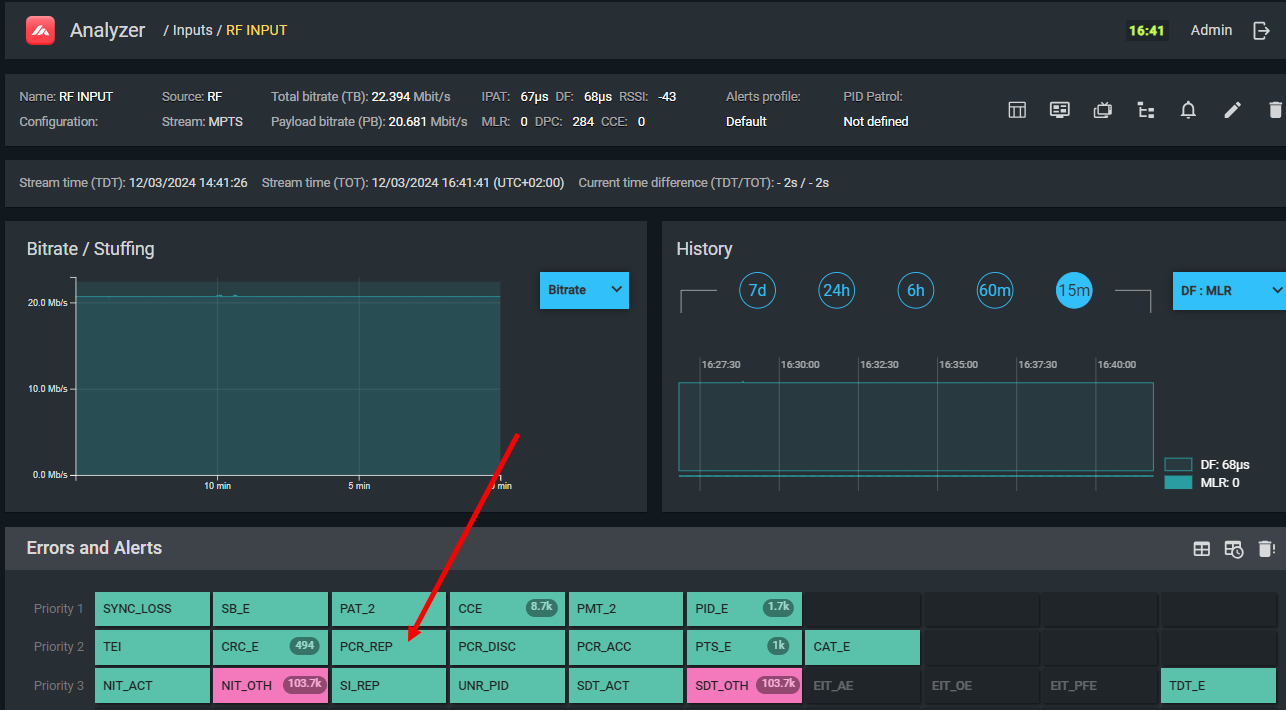
2.3a PCR_repetition_error
Abbreviation: PCR_REP
Frequency: Very common
What it means
PCR values are arriving less frequently than once every 100 ms on the PCR PID. PCR must be transmitted at regular, frequent intervals for the decoder's internal clock to remain synchronized with the encoder.
Conditions for valid use
- No CCE on the PCR PID
- Service should have a constant bitrate (CBR)
Causes
- PCR transmission interval intentionally set longer than 100 ms in the multiplexer (to conserve bandwidth)
- Significant network jitter causing PCR packets to arrive irregularly
- VBR service (in this case PCR is not meaningful; the error can be disabled in the TS Analyzer profile)
Recommendations
If the error produces no visible symptoms, it can be ignored. If image distortion occurs, reduce the PCR transmission interval to 100 ms or less in the multiplexer. For VBR services, disable this check in the input's error profile.
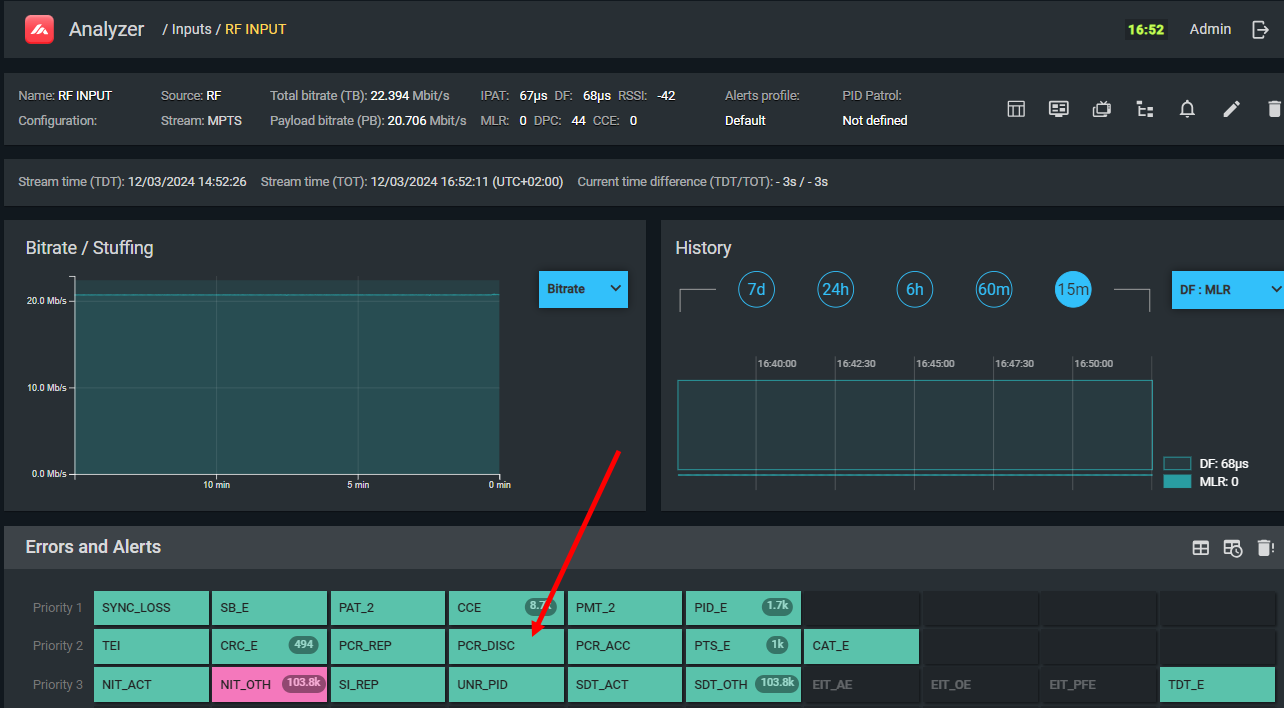
2.3b PCR_discontinuity_indicator_error
Abbreviation: PCR_DISC
Frequency: Very rare
What it means
There has been a sudden jump in PCR value without the PCR_discontinuity_indicator flag being set — or the flag was set without a corresponding PCR jump.
When an encoder or multiplexer changes configuration (e.g., bitrate, compression parameters), the PCR value may legitimately jump. The PCR_discontinuity_indicator flag signals to decoders that this jump is intentional and should not be treated as an error.
Causes
- Encoder or multiplexer does not implement the
PCR_discontinuity_indicatorflag correctly - Software fault in the encoder or multiplexer
Recommendations
Restart the affected service on the multiplexer. If the error persists, the encoder or multiplexer firmware may need to be updated.
Relationship to other errors
If this error appears simultaneously with PCR_accuracy_error (2.4), the accuracy error should be disregarded — a discontinuity will naturally cause the accuracy calculation to produce an erroneous result.
2.4 PCR_accuracy_error
Abbreviation: PCR_ACS
Frequency: Very common
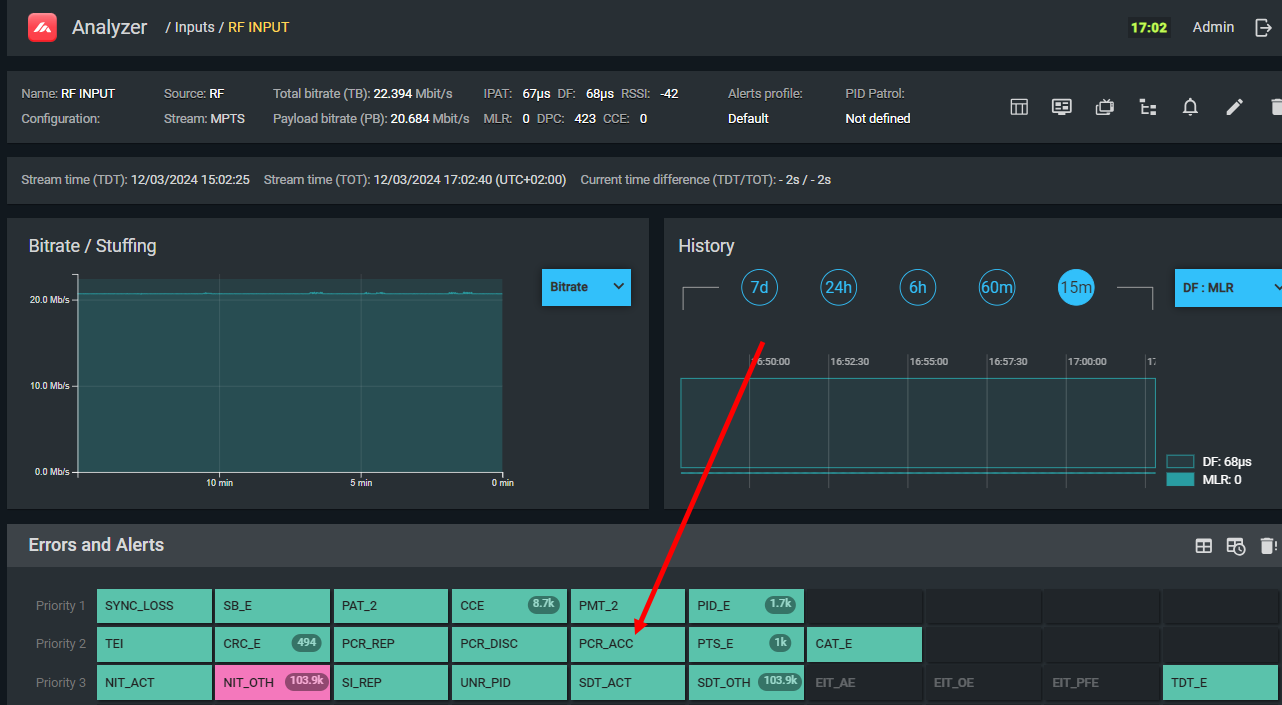
What it means
The PCR value deviates from its expected value by more than ±500 nanoseconds. The expected value is calculated by TS Analyzer based on the measured constant bitrate.
This error is a quick indicator that a service's bitrate is variable. If the multiplexing scheme specifies VBR for this service, the error is expected and should be suppressed in the profile.
Conditions for valid use
- No CCE on the PCR PID
- No active PCR_discontinuity_indicator_error (2.3b)
- Service must have constant bitrate (CBR)
Causes
- Encoder or multiplexer reference clock has insufficient accuracy (CPU overload, overheating, power supply instability)
- Software bug in PCR insertion logic
- Service has variable bitrate (expected — disable in profile)
Recommendations
For CBR services with this error: verify encoder is not overloaded (check CPU and temperature), verify power supply is clean, restore encoder or multiplexer software. For VBR services: disable this check in the TS Analyzer profile.
2.5 PTS_error
Abbreviation: PTS_E
Frequency: Very rare
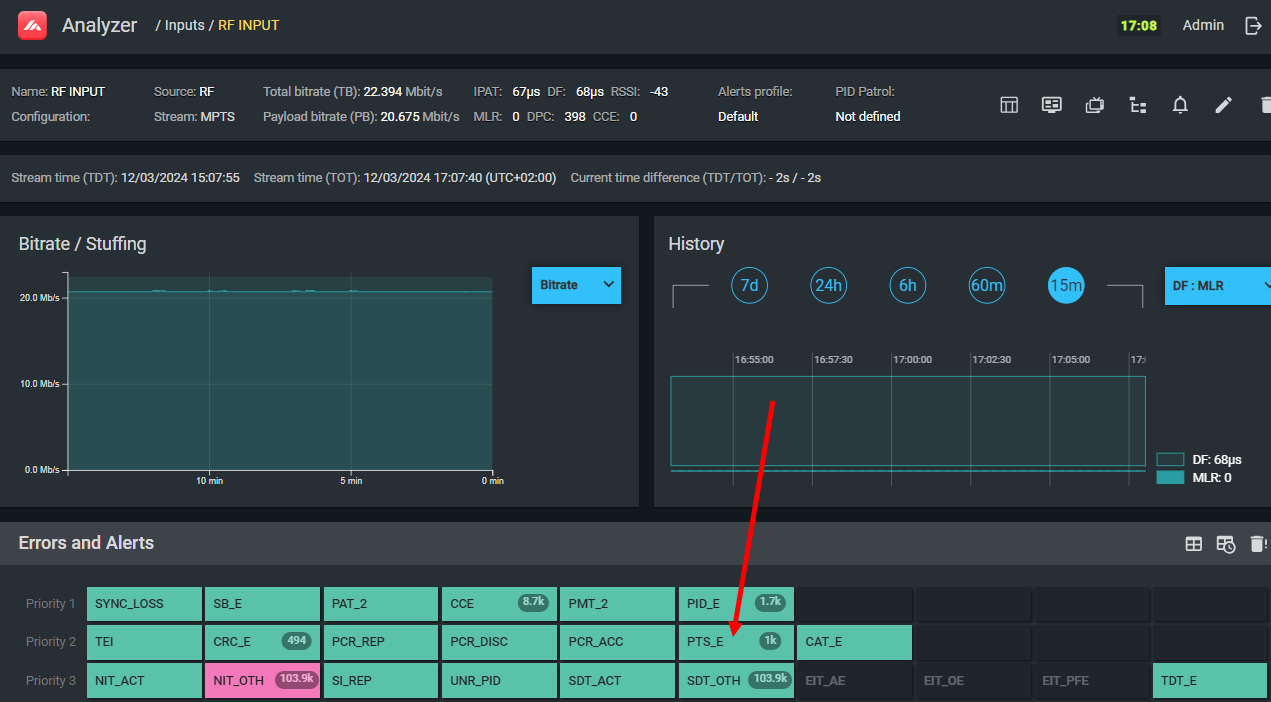
What it means
PTS timestamps are absent from an unscrambled elementary stream, or are arriving less frequently than once every 700 ms. This error checks only the presence of PTS, not its correctness — for content accuracy, see Bitrates & Timestamps.
Conditions for valid use
- The PID carries an unscrambled elementary stream
- No CCE on the PID
Causes
- Faulty encoder
- PTS interval incorrectly configured in the encoder settings
Recommendations
Restore the encoder (restart, re-flash). If the PTS interval is configurable in encoder settings, set it to 700 ms or shorter.
2.6 CAT_error
Abbreviation: CAT_E
Frequency: Rare
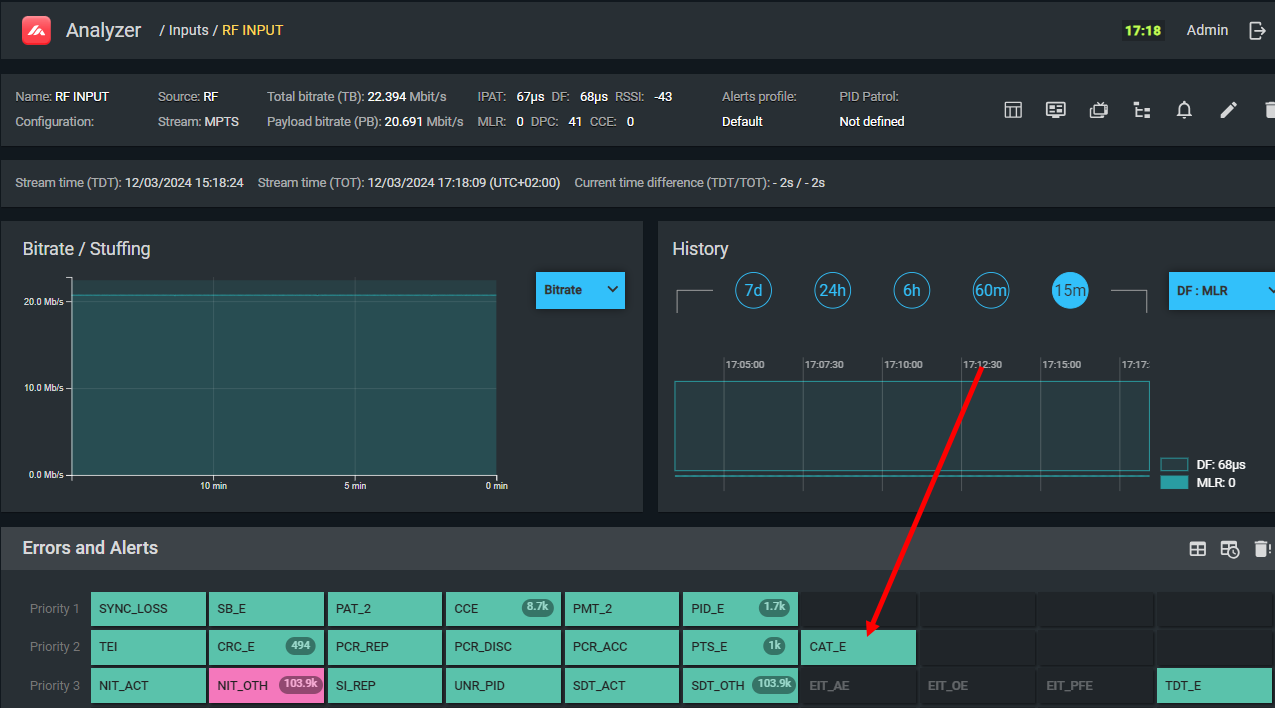
What it means
Scrambled PIDs are present in the stream but the Conditional Access Table (CAT) on PID 1 is absent or arriving too infrequently. Without the CAT, subscriber devices cannot find the EMM streams containing the keys needed to descramble services.
Despite being classified as Level 2, this is functionally a Level 1 error for any stream using conditional access — a missing CAT makes descrambling impossible.
Activation conditions
- At least one PID has the scrambling flag set in its TS packet header, AND the CAT has been absent for more than 1 second.
- A section with a
table_idother than 0x01 appears on PID 1.
Note: For FTA (unscrambled) streams, this error is irrelevant and should be disabled in the profile.
Causes
- CAS server fault
- Multiplexer fault
- CAT transmission disabled or misconfigured
Symptoms
Scrambled services fail to descramble — permanently or intermittently — on subscriber devices.
Recommendations
Restore the multiplexer or CAS server per the CAS provider's technical documentation. Contact the CAS provider's support if the issue persists. See CAS Monitoring for a complete diagnostic approach.