Level 3 — Informational Errors
Level 3 errors are generally the lowest priority, but some can cause real problems in specific scenarios — particularly those involving EPG display, channel switching, or CAS behavior.
Prerequisite: Confirm there are no CCE errors on the relevant PIDs before investigating Level 3 errors.
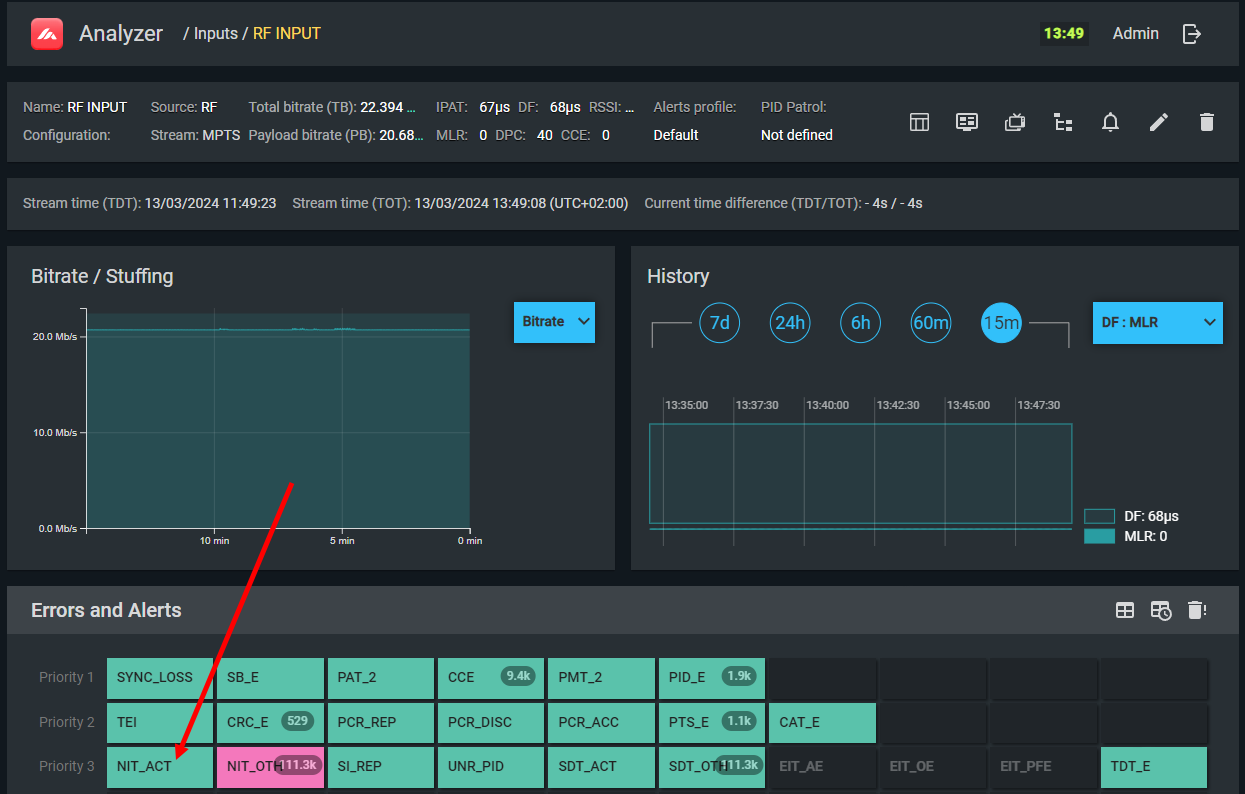
3.1 NIT_error
Status: Deprecated. Use 3.1a NIT_actual_error and 3.1b NIT_other_error instead.
3.1a NIT_actual_error
Abbreviation: NIT_ACT
Frequency: Common
Practical severity: Low–Medium
What it means
The NIT_actual table on PID 16 (0x10) has been absent for more than 10 seconds, is being transmitted too frequently (more than once per 25 ms), or contains unexpected table_ids.
When it matters
Many set-top boxes ignore NIT_actual entirely. However, some devices treat its absence as an indication that the stream is not a valid DVB signal and refuse to process it. In some conditional access systems, a missing NIT can cause descrambling failures. For IP television streams, NIT_actual is typically absent — suppress this error in the profile.
Causes
- Operator intentionally excluded NIT or extended its interval to save bandwidth
- Multiplexer or PSI/SI generator software fault
Recommendations
Enable NIT_actual in the multiplexer or PSI/SI generator with a repetition interval between 25 ms and 10 s (9.9 s is typical). Restore multiplexer software if the table is present in configuration but not being transmitted.
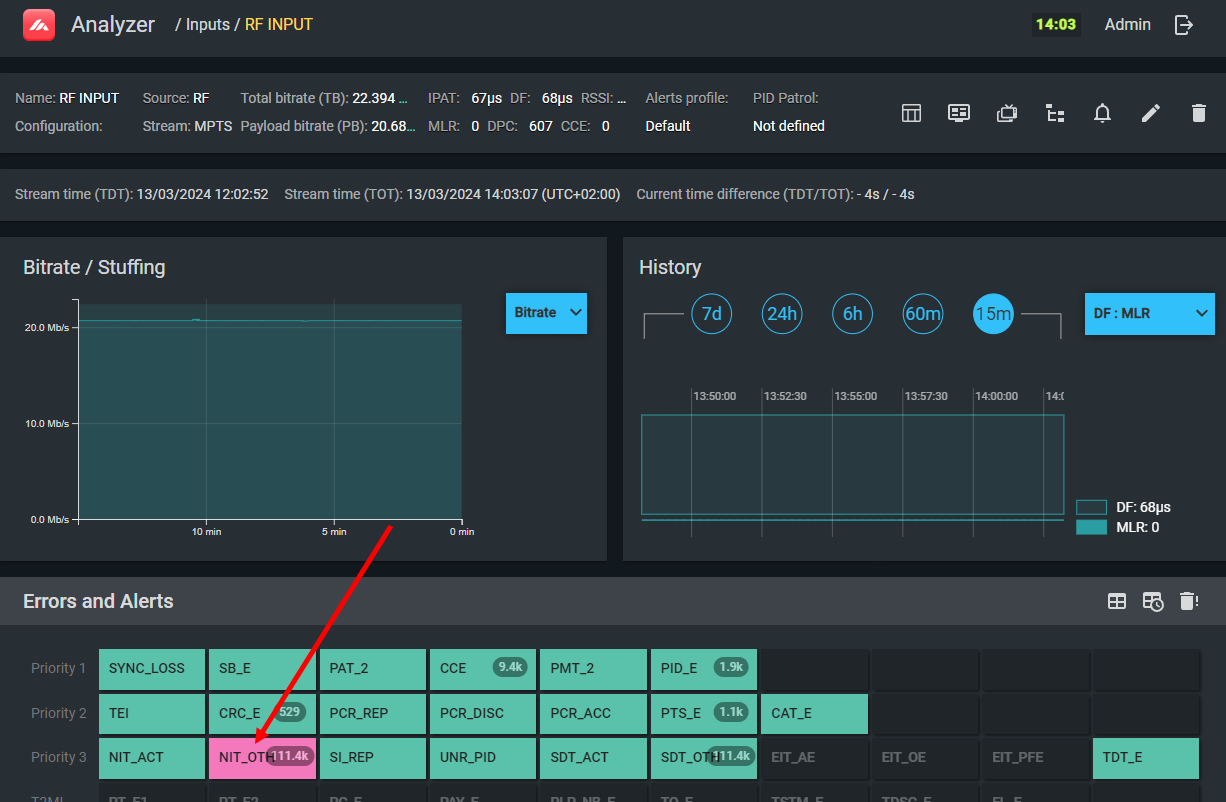
3.1b NIT_other_error
Abbreviation: NIT_OTH
Frequency: Common
Practical severity: Very low
What it means
The NIT_other table on PID 16 has been absent for more than 10 seconds. NIT_other is used to reduce channel-switching time between TSes. In most deployments, NIT_other is not used — suppress this error in the profile.
Recommendations
Same as NIT_actual_error. If NIT_other is not needed in your network, disable this check in the TS Analyzer profile.
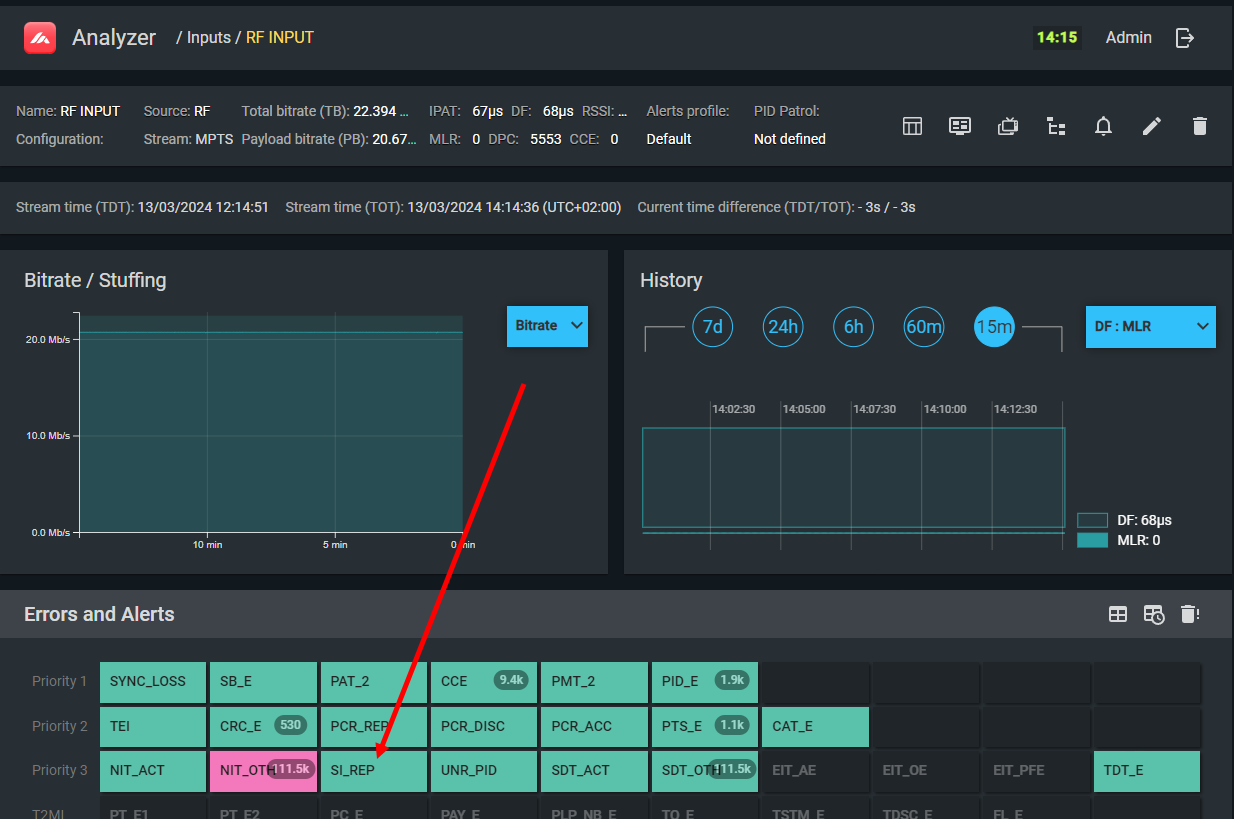
3.2 SI_repetition_error
Abbreviation: SI_REP
Frequency: Common
Practical severity: Medium
What it means
A PSI/SI table is being transmitted either too frequently or too infrequently — outside the timing windows required by the relevant standard. The error log specifies which PID and therefore which table is affected.
Timing requirements
| Table | Minimum interval | Maximum interval | Mandatory |
|---|---|---|---|
| PAT | 25 ms | 0.5 s | Yes |
| PMT | 25 ms | 0.5 s | Yes |
| CAT | 25 ms | 0.5 s | No |
| SDT actual | 25 ms | 2 s | No |
| SDT other | 25 ms | 10 s | No |
| NIT actual | 25 ms | 10 s | No |
| NIT other | 25 ms | 10 s | No |
| BAT | 25 ms | 10 s | No |
| EIT p/f actual | 25 ms | 2 s | No |
| EIT p/f other | 25 ms | 10 s | No |
| TDT | 25 ms | 30 s | No |
| TOT | 25 ms | 30 s | No |
| RST | 25 ms | 30 s* | No |
*Values marked with * are not specified by the standard but chosen by TS Analyzer.
Causes
- Incorrect multiplexer or PSI/SI generator configuration
- Faults in the multiplexer or EPG/CAS server software
Recommendations
Adjust the transmission interval for the affected table in the multiplexer or PSI/SI generator to a value within the allowed range. For tables such as SDT and EIT, setting the interval close to the maximum is appropriate because subscriber devices cache these tables.
3.3 Buffer_error
Status: Not implemented in TS Analyzer.
This error is a theoretical precursor to CCE and is of secondary diagnostic value. Its occurrence would indicate buffer underflow or overflow in a TS-receiving device. In practice, diagnosing buffer problems is done by examining CCE error patterns — see 1.4 Continuity_count_error.
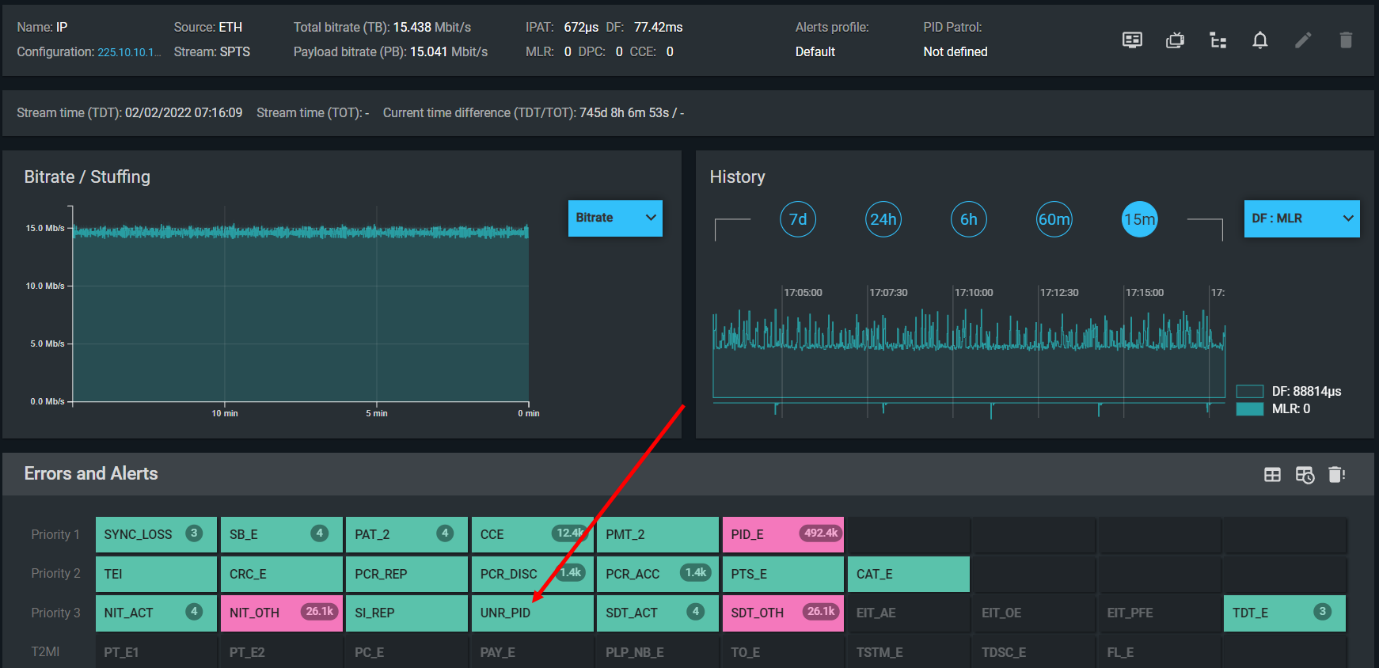
3.4 Unreferenced_PID
Abbreviation: UNR_PID
Frequency: Common
Practical severity: Medium
What it means
A PID is present in the transport stream that has no reference in PAT, PMT, CAT, or any other PSI/SI table, and is not a standard system PID defined by DVB or MPEG standards.
When it is expected
Some systems intentionally inject PIDs without registering them in PSI/SI:
- OTA (over-the-air) firmware update systems for set-top boxes
- CAS implementations not using Simulcrypt
- Emergency alert or device control systems
If the "unknown" PID is intentional, suppress this check for that PID or add it to the exception list.
When it indicates a problem
- The multiplexer has placed a PID in the stream without adding it to PAT or PMT (software bug)
- A previously referenced PID lost its PSI/SI reference due to a PAT or PMT error
- A faulty remultiplexer is generating random PID values (in this case UNR_PID errors will grow rapidly and continuously)
Recommendations
- Check the multiplexing scheme — is this PID supposed to be there?
- If yes: it is intentionally unregistered. No action needed.
- If no: check for PAT/PMT errors that may have lost the reference. Restore the multiplexer configuration.
3.5 SDT_error
Status: Deprecated. Use 3.5a SDT_actual_error and 3.5b SDT_other_error instead.
3.5a SDT_actual_error
Abbreviation: SDT_ACT
Frequency: Common
Practical severity: Medium
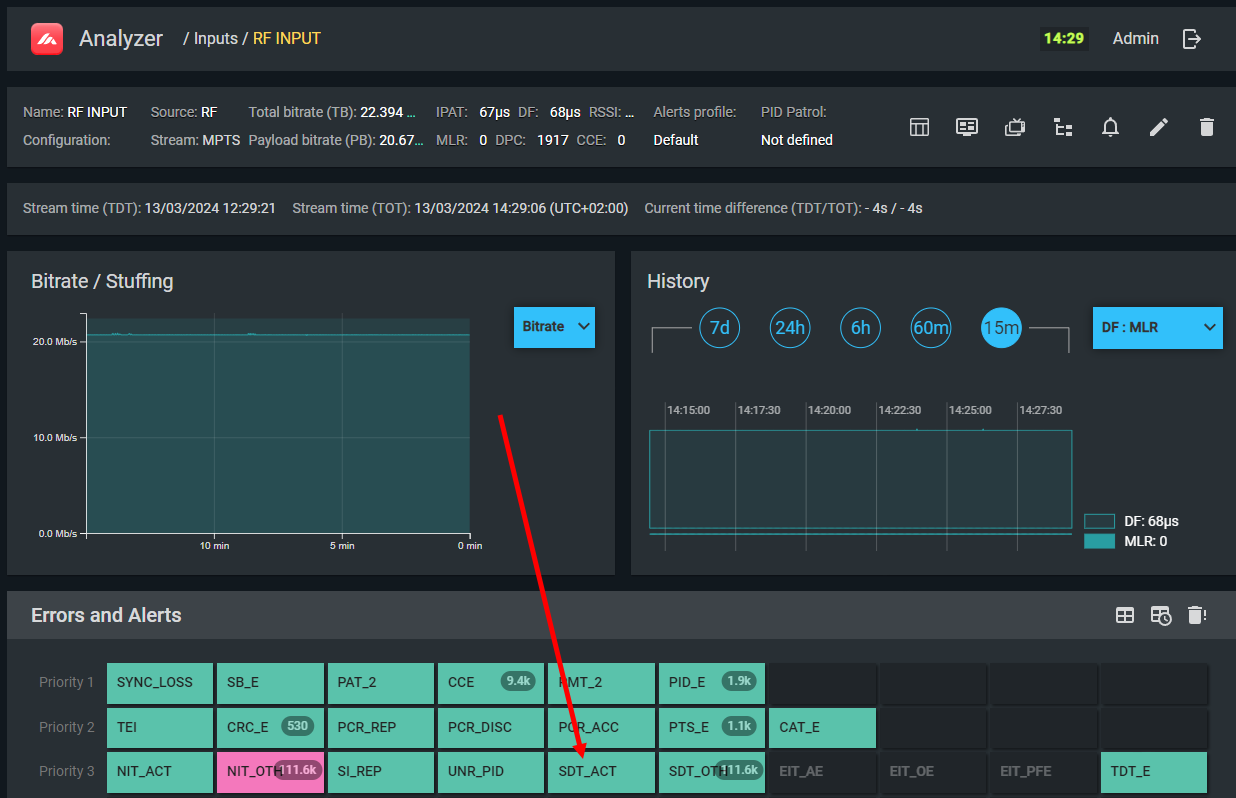
What it means
The SDT_actual table on PID 17 (0x11) is absent, arriving too infrequently (more than 2 s), or too frequently (less than 25 ms). Content is not checked — only timing compliance.
Symptoms
- Service names absent or showing outdated information on subscriber devices
- Delay before service names appear after switching channels
- If transmitted too frequently: unnecessary bandwidth consumption, potential CCE across the stream
Recommendations
Set the SDT_actual transmission interval between 25 ms and 2 s (closer to 2 s is preferable, as devices cache it). If foreign sections are appearing on PID 17, restore the multiplexer (reboot, re-flash).
3.5b SDT_other_error
Abbreviation: SDT_OTH
Frequency: Rare
Practical severity: Low
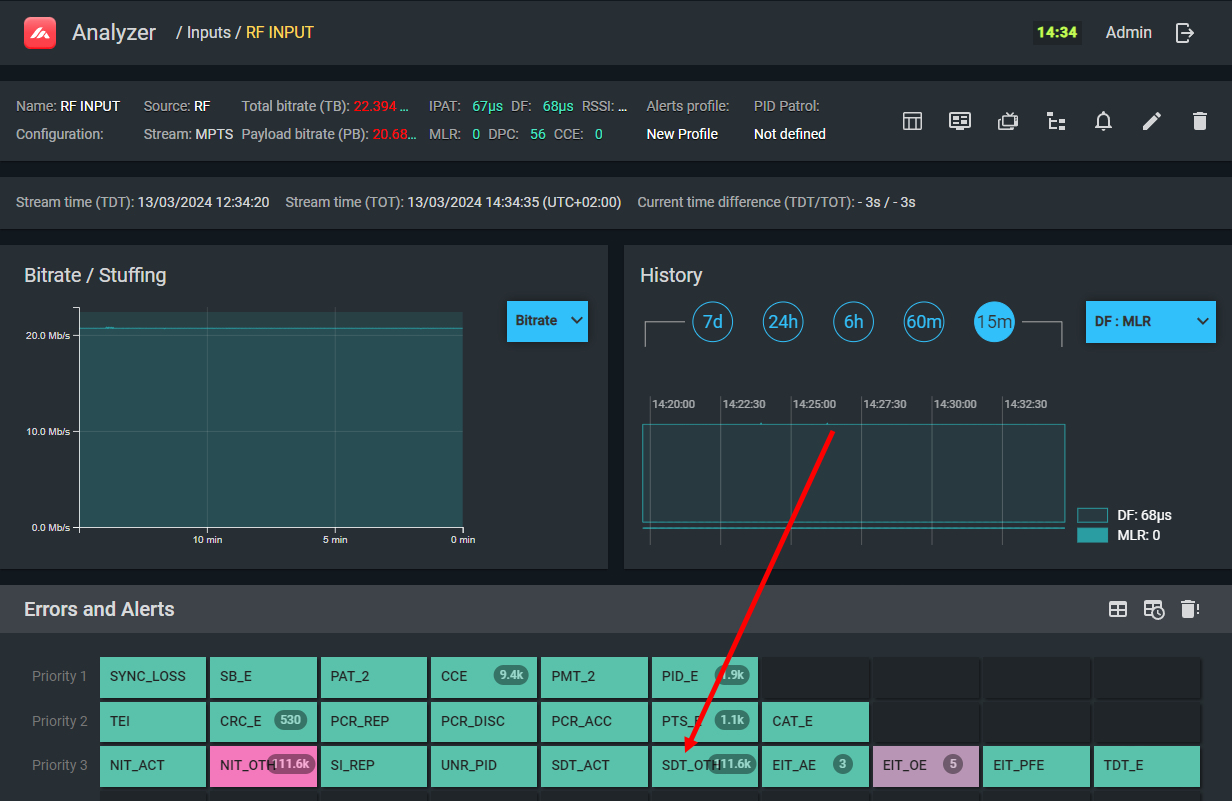
What it means
The SDT_other table on PID 17 has been absent for more than 10 seconds. Its absence causes a brief delay when switching between services on different TSes. If your network has only one TS, suppress this error in the profile.
Recommendations
Set the SDT_other transmission interval to within 10 s in the multiplexer or PSI/SI generator. If SDT_other is not needed, disable this check in the profile.
3.6 EIT_error
Status: Deprecated. Use 3.6a, 3.6b, and 3.6c instead.
3.6a EIT_actual_error
Abbreviation: EIT_AE
Frequency: Common
Practical severity: Low–Medium
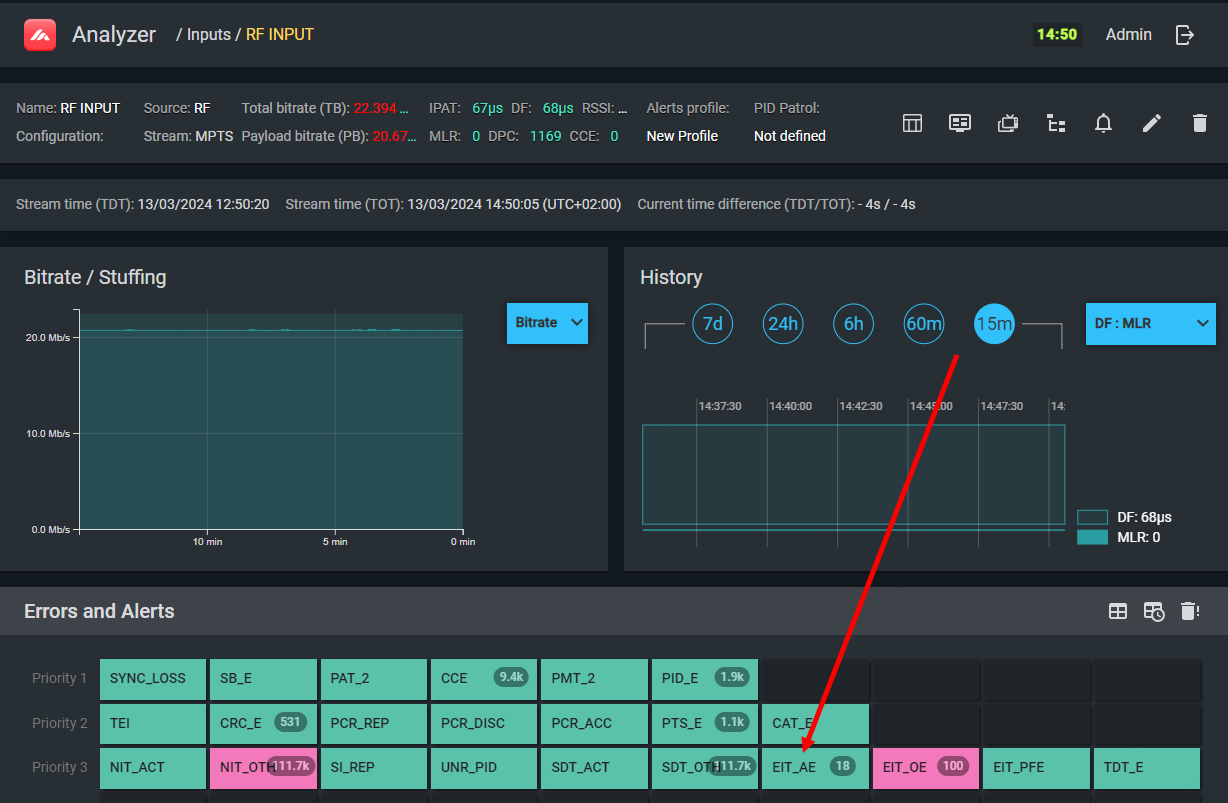
What it means
EIT_actual sections on PID 18 (0x12) are absent for more than 2 seconds, arriving too frequently, or contain unexpected table_ids.
Causes
- Multiplexer, PSI/SI generator, or EPG server misconfiguration
- Operator intentionally increased EIT interval to save bandwidth (EIT can consume up to 1 Mbps)
- EPG server software fault
Recommendations
Set EIT_actual transmission interval between 25 ms and 2 s (closer to 2 s is preferable). See EPG / EIT Monitoring for a full diagnostic approach.
3.6b EIT_other_error
Abbreviation: EIT_OE
Frequency: Very common
Practical severity: Low
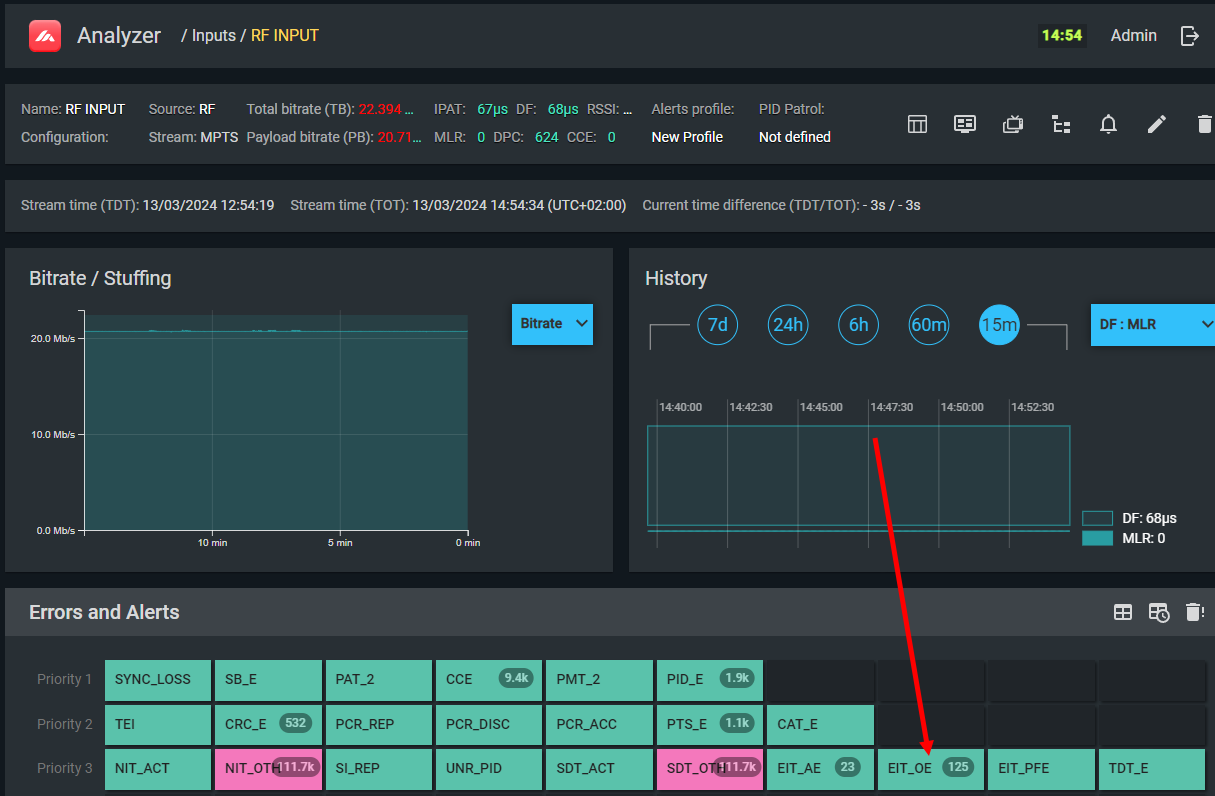
What it means
EIT_other sections on PID 18 have been absent for more than 10 seconds. This only affects EPG loading speed when viewers switch to services on different TSes. If EIT_other is not used in your network, disable this check in the profile.
Recommendations
Set EIT_other transmission interval within 10 s. If not needed, suppress the error in the profile.
3.6c EIT_PF_error
Abbreviation: EIT_PFE
Frequency: Very common
Practical severity: Low–Medium
What it means
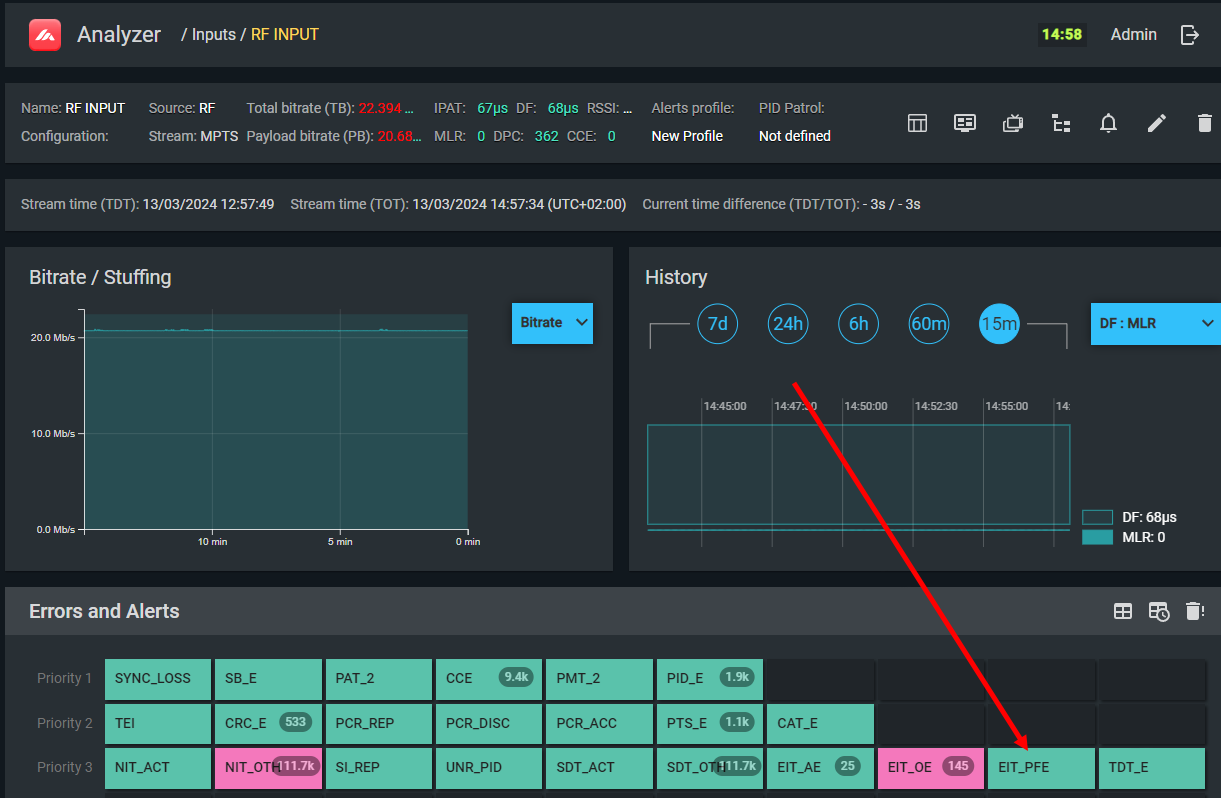
The standard requires EIT_actual to contain both section 0 (current program) and section 1 (next program). It is prohibited to transmit only one of them. This error activates when either section is missing within the expected interval.
Causes
- EPG server software fault (generates only "current" or only "next" section)
- Multiplexer software fault
Recommendations
Restore the EPG server or multiplexer software (restart, reboot the service, re-flash). Both section 0 and section 1 must be transmitted.
3.7 RST_error
Status: Not automatically monitored by TS Analyzer.
The RST (Running Status Table) on PID 19 (0x13) is rarely used. TS Analyzer does not generate this error automatically. To manually verify RST transmission, locate PID 19 in the statistics screen — if it is present and has traffic, RST is being transmitted. Content can be inspected on the PSI/SI screen.
3.8 TDT_error
Abbreviation: TDT_E
Frequency: Rare
Practical severity: High
What it means
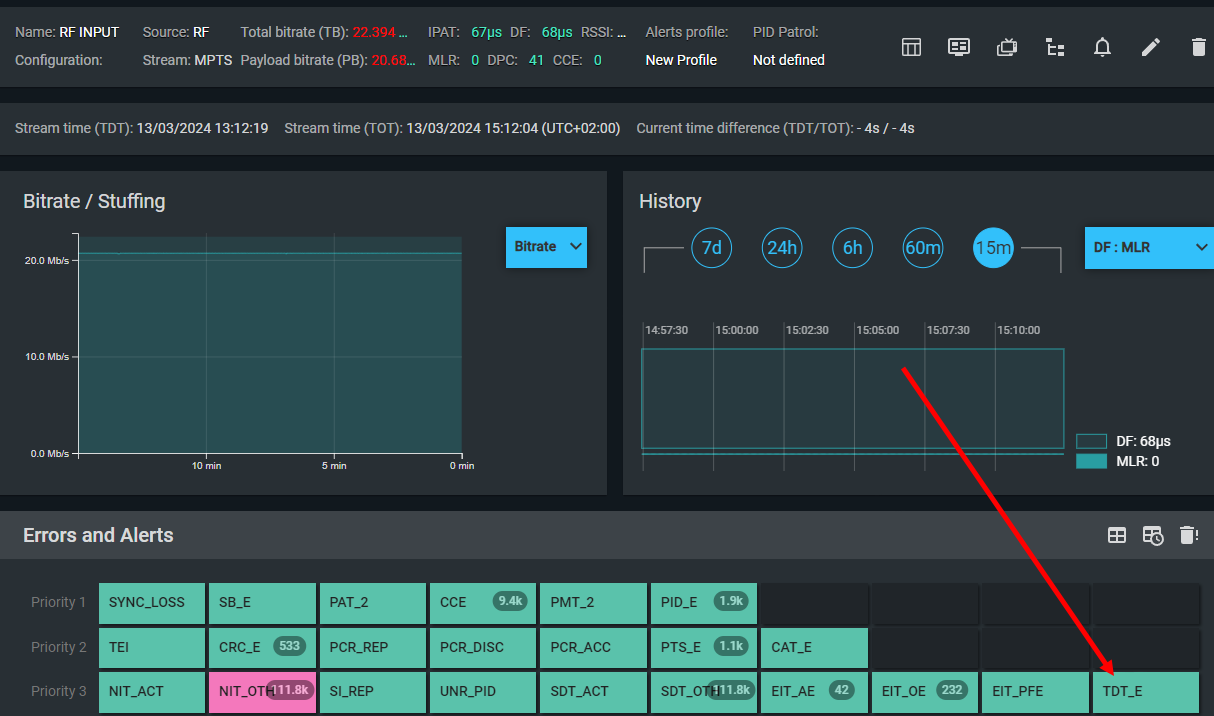
The TDT table (UTC time information) on PID 20 (0x14) is absent, arriving too infrequently (more than 30 s), too frequently (less than 25 ms), or PID 14 contains unexpected table_ids.
Despite being Level 3, the consequences are concrete and affect subscriber experience directly.
Activation conditions
- No section with table_id = 0x70 on PID 14 for more than 30 seconds
- Foreign sections appear on PID 14
- TDT transmitted more frequently than every 25 ms
Causes
- PSI/SI generator configuration error (TDT not enabled, or interval too long)
- External time reference fault (GPS, GLONASS)
- Multiplexer software fault
Symptoms
- Subscriber device displays incorrect time
- EPG schedule shown for the wrong time slot
- Scheduled recordings trigger at wrong times
Recommendations
Verify TDT is enabled in the PSI/SI generator with a transmission interval between 25 ms and 30 s. Verify the external time reference (GPS/GLONASS) is locked if one is used. Restore multiplexer software if needed (restart PSI/SI generation, reboot, firmware update). See UTC Time Monitoring for checking time accuracy in the stream.